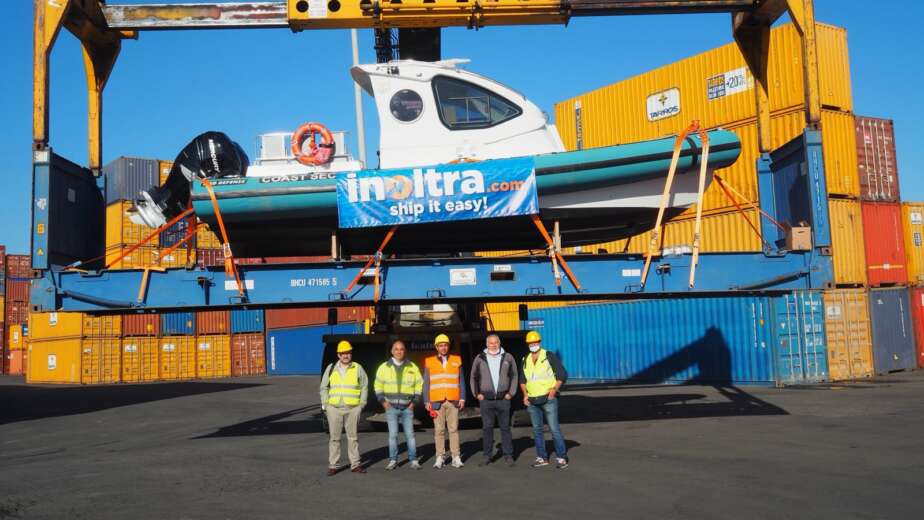
A door-to-door heavy-lift case study covering exceptional road transport, OOG flat-rack shipping, port handling and destination readiness in Libya.
Transporting a 50-tonne, 13-metre turbine rotor from Switzerland to Libya is not a standard freight booking. It is a project logistics operation in which every decision, from trailer configuration and terminal timing to cargo securing and destination readiness, must be taken in the right order.
Inoltra’s project cargo division coordinated the door-to-door movement of a 50-tonne turbine rotor for GE from Switzerland to Libya via the Port of Genoa. The shipment has now completed its journey and arrived safely at its final destination in Libya. The scope combined exceptional road transport, heavy-lift handling, a 40-foot flat rack, ocean freight and destination coordination. The cargo moved through several operating environments; the real challenge was keeping every handover connected to one transport plan.
| THE SHIPMENT AT A GLANCE | |
|---|---|
| Cargo | Turbine and generator parts (industrial rotor) for GE |
| Dimensions | 13.0 m x 2.10 m x 2.10 m |
| Gross weight | 50 tonnes (50,000 kg) |
| Routing | Switzerland -> Port of Genoa -> Libya |
| Equipment | 40-foot flat rack; out-of-gauge and over-length cargo |
| Inoltra scope | Permits, escort, port handling, lashing and securing, ocean freight and destination coordination |
Why project cargo planning starts with verified cargo data
Standard freight is designed to fit established equipment and repeatable procedures. Project cargo works in the opposite direction: the transport method has to be built around the cargo. A standard closed 40-foot container has an internal length of approximately 12.03 metres and a typical payload of around 26-28 tonnes. At 13 metres and 50 tonnes, this rotor exceeded both limits and concentrated its weight on a relatively small footprint.
Those characteristics influence every downstream decision. The planning team needs confirmed weight and dimensions, weight distribution, centre of gravity, lifting points, handling drawings, packaging requirements and access conditions at origin and destination. If any of this information is incomplete, the problem often appears at the most expensive moment – when the cargo reaches a terminal or changes transport mode.
For that reason, a dependable project-cargo quotation is not produced from an approximate weight and two addresses. It is the result of a technical review that connects the cargo data to the trailer, route, lifting method, shipping equipment and receiving arrangements. In heavy-lift transport, good engineering is not an additional service around the booking; it is what makes the booking executable.
Exceptional road transport from Switzerland to Genoa
The inland leg was performed as an exceptional, or abnormal-load, road movement. Special permits were required for the weight and dimensions, the route had to be planned and approved, and escort was arranged for the transit. For a load in this class, the road plan also needs to match the selected trailer and axle configuration to permitted axle loads while considering bridge and tunnel clearances and the transit windows imposed by the authorisations.
These checks are the practical basis of route feasibility for project cargo. They reduce the chance of discovering, after mobilisation, that a turn cannot be negotiated, a clearance is insufficient or a permit condition conflicts with the operating schedule. Yet the road route is only one part of the problem. The truck also has to arrive at Genoa within the terminal’s agreed operational window and in time for the booked maritime service.
This is why the inland movement was planned backwards from the port operation rather than treated as an isolated delivery. An early arrival can create staging and storage constraints for a 50-tonne unit; a late arrival can affect handling resources, terminal cut-offs and the planned sailing. Inoltra’s role was therefore not limited to sourcing a heavy haulier. It was to align permits, escort, road timing and terminal readiness with the next phase of the transport.
At Genoa, road transport becomes a maritime operation
The Port of Genoa was the transfer point between two very different operating environments. It was also the most sensitive interface in the movement because the road haulier, terminal personnel, heavy-lift handling providers, ocean carrier and documentation teams all had to converge within a limited time window.
For a 50-tonne, 13-metre unit, transhipment requires a defined lifting approach. The lifting points must be confirmed, the spreaders and slings must be suitable for the geometry of the cargo, and the handling equipment must be rated for the load. The rotor was positioned and loaded onto a 40-foot flat rack, creating the connection between the exceptional road movement and the containerised liner service to Libya.
A port handover can fail even when every individual supplier performs its own task correctly. The truck may arrive outside the lifting window, the equipment may not be positioned, the documentation may be ready for the terminal but incomplete for the carrier, or the flat rack may not be available when required. Project cargo coordination is therefore largely the management of interfaces: making sure that the output of one phase is exactly what the next phase is prepared to receive.
Flat rack or breakbulk: selecting the sea-freight method
Oversized industrial equipment is commonly evaluated for either out-of-gauge flat-rack shipping or breakbulk transport. The correct choice depends on more than dimensions alone. Weight distribution, load concentration, lifting requirements, equipment ratings, carrier acceptance, sailing options, port capabilities and destination handling all need to support the same solution.
For this project, the 40-foot flat rack allowed the over-length, over-weight unit to move within a containerised liner service. The equipment was not selected simply because it had no side walls. It was selected as part of an integrated method in which the road trailer, terminal lift, securing arrangement, vessel stowage and destination operation could all be coordinated around the same cargo unit.
Breakbulk shipping remains an important alternative when the dimensions, weight, lifting geometry or routing do not suit flat-rack equipment. A capable project-cargo forwarder should be able to evaluate both methods and explain the operational consequences, rather than forcing every heavy shipment into the same transport format.
Securing 50 tonnes for the sea passage to Libya
Once at sea, the rotor was exposed to conditions that do not exist in the same form on the road: vessel accelerations in roll and pitch, vibration, salt atmosphere and changes in load direction. The lashing and securing arrangement therefore had to be appropriate for maritime transport and for a 50-tonne unit, with suitable securing points, lashing angles and pre-tension in line with the principles of the CTU Code.
This work cannot be improvised after the cargo reaches the quay. The securing concept has to be considered while the equipment and lifting method are still being selected, because the position of the cargo on the flat rack affects load distribution, access to securing points and vessel acceptance. Packaging and protection also form part of the same planning process, particularly for critical rotating equipment exposed to weather and a marine environment.
For industrial and energy projects, the commercial risk is much larger than the freight invoice. Damage or delay to one rotor can affect installation, commissioning and the critical path of the wider project. The objective is therefore not merely to move the cargo at the lowest transport rate, but to protect the continuity of the project around it.
| The cargo changed transport modes several times; responsibility for the overall plan did not. |
|---|
Destination readiness in Libya starts before the vessel sails
The Libyan phase was prepared while the cargo was still in Europe. Shipping documentation, customs-clearance requirements, arrival procedures, handling equipment and onward transport all had to be addressed before departure. The guiding principle was simple: the cargo should not arrive before the destination was ready to receive it. The rotor subsequently arrived safely at its final destination in Libya, completing the door-to-door movement.
This matters on every project route, but it is particularly important on the Italy-Libya logistics corridor, where successful execution depends on disciplined documentation and close coordination between the European origin and the receiving side. Unlike a standard container, a 50-tonne OOG unit needs specific space, suitable cranage, an agreed release sequence, an onward vehicle and a receiving site prepared for the delivery.
Tracking can show where the cargo is, but it cannot arrange a crane, complete missing paperwork or create space at the destination. Inoltra’s door-to-door scope connects freight forwarding with customs coordination, destination handling and final delivery planning. That local execution capability is what turns a maritime arrival into a completed industrial movement.
What door-to-door means in project logistics
In standard freight, door-to-door often means that collection and delivery are included in the same quotation. In project logistics, it should mean something more demanding: one party accepts responsibility for how the individual services work together.
This movement involved the manufacturer, the loading team, the exceptional road haulier, the Genoa terminal, heavy-lift handling providers, the ocean carrier, customs representatives and the receiving side in Libya. The main operational risk rarely sits inside one service. It appears between services, when a terminal slot does not match the road permit, when documentation is sufficient for one phase but incomplete for the next, or when the cargo is ready but destination equipment is not.
Inoltra’s project-cargo role was to own those interfaces and preserve continuity from origin to destination. Permits, escort, handling, lashing, ocean freight and destination coordination were not treated as separate bookings placed on one invoice. They were managed as one transport plan for one critical piece of equipment.
What this project demonstrates about Inoltra
The completed shipment demonstrates a set of capabilities that industrial, infrastructure and energy clients need when cargo moves beyond standard limits: technical review of cargo data, exceptional road transport, route and permit coordination, heavy-lift terminal handling, OOG flat-rack shipping, maritime securing, customs preparation and destination execution in Libya.
More importantly, it shows how those capabilities are combined. The value of project logistics is not the number of suppliers involved; it is the ability to make their work function as one controlled sequence. For EPC contractors, OEMs and project owners, that single-accountability model reduces the risk of gaps appearing between the factory, the port, the vessel and the final site.
Planning a heavy-lift, breakbulk or out-of-gauge shipment between Europe and Libya? Involve Inoltra before the route, equipment and handling method are finalised. Early review is the point at which constraints can still be solved on paper, before they become delays at the roadside, terminal or destination.
About Inoltra
Inoltra is an international logistics and procurement company specialising in complex movements between Europe, Libya and other demanding markets. Its services include project cargo, freight forwarding, customs coordination, procurement logistics and door-to-door delivery for industrial, infrastructure, energy and institutional clients. The company’s role extends beyond transport booking to compliance, destination execution and the operational interfaces where delays and risk are most likely to arise.
Frequently asked questions
What is out-of-gauge cargo?
Out-of-gauge, or OOG, cargo exceeds the dimensions or payload that can be accommodated inside a standard closed container. Industrial rotors, generators, transformers and process equipment may move on flat racks, in open-top units or as breakbulk cargo, depending on their weight, geometry and handling requirements.
Why was a 40-foot flat rack used for this rotor?
The rotor was 13 metres long and weighed 50 tonnes, so it could not be containerised conventionally. A 40-foot flat rack provided an OOG equipment solution compatible with the selected liner service, subject to the required lifting, load-distribution, securing and carrier-acceptance arrangements.
What is required to ship heavy machinery to Libya?
A reliable plan must connect origin handling, exceptional transport where required, port operations, sea freight, shipping documentation, customs-clearance preparation, destination handling equipment and onward delivery. The destination phase should be organised before the cargo leaves Europe.
What is the difference between heavy lift and project cargo?
Heavy lift describes cargo that requires specialised lifting or handling because of its weight. Project cargo is the broader logistics discipline that connects technical data, permits, transport equipment, port operations, sea freight, compliance and destination delivery into one coordinated plan.
Can project cargo move on a container vessel?
Yes. Suitable cargo may move as OOG freight on a flat rack or open-top unit within a container liner service, subject to equipment ratings, load concentration, securing and carrier acceptance. Cargo that does not suit container equipment may instead move as breakbulk on a multipurpose or conventional vessel.
When should project-cargo planning begin?
Planning should begin as soon as certified dimensions, weight, lifting details and destination information are available, ideally before transport equipment and shipping methods are fixed. Early technical review provides more options and makes incorrect assumptions less expensive to correct.